
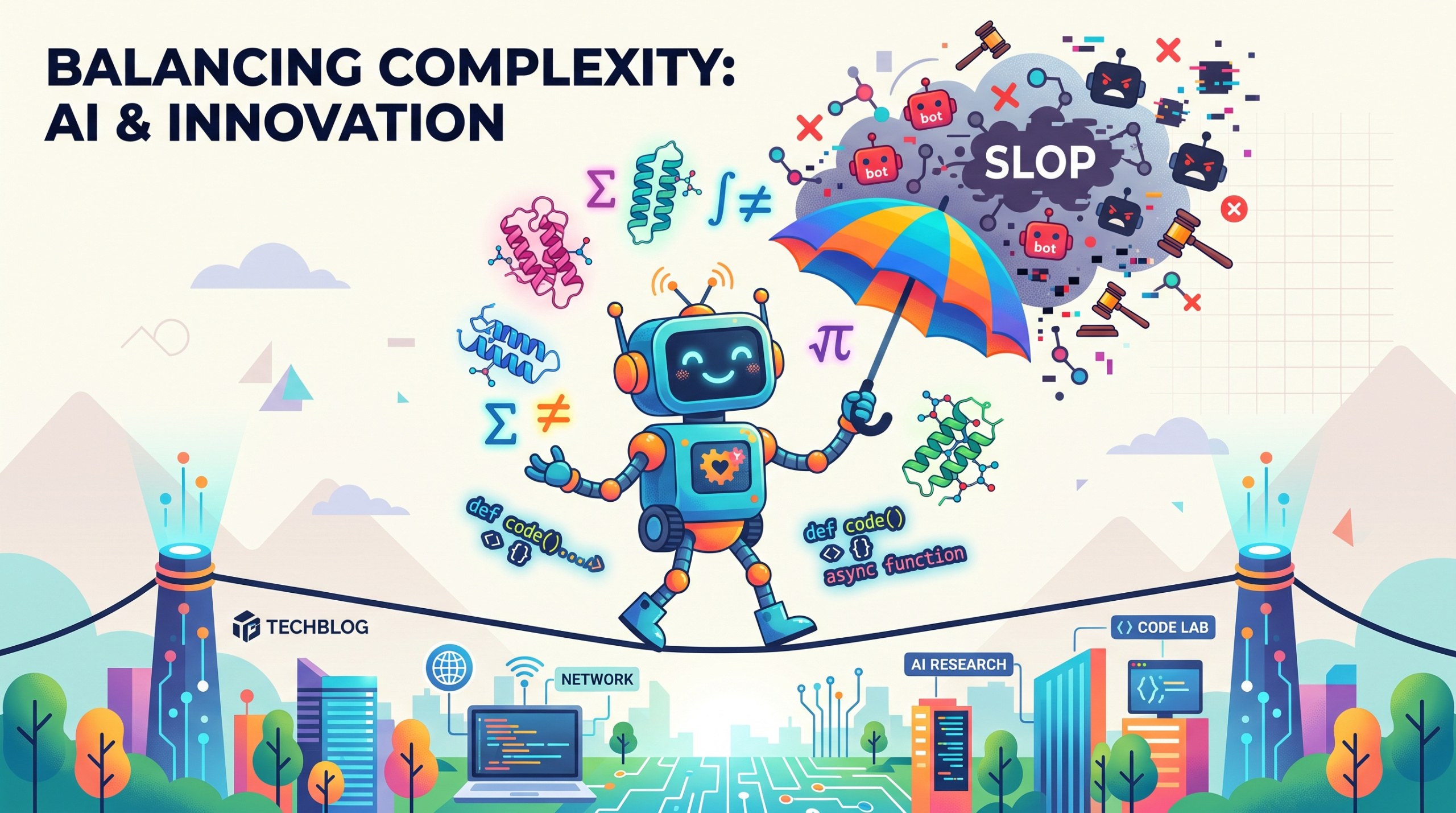
The Great Algorithmic Acceleration: Innovations, Operational Utilities, and Systemic Anxieties in Modern Artificial Intelligence
The global artificial intelligence landscape is defined by a profound structural tension. Technological capabilities across multi-modal reasoning, architectural efficiency, and computational biology are advancing at an extraordinary rate, unlocking enterprise value and scientific breakthroughs. Concurrently, the rapid deployment of these technologies has generated widespread institutional, legal, and social friction. Modern organizations navigate an ecosystem where algorithmic adoption has become near-universal, yet public trust is eroding, training commons are shrinking, and systemic vulnerabilities—ranging from synthetic content saturation to severe labor market realignments—are expanding rapidly.
This research report evaluates the current trajectory of artificial intelligence across three interconnected dimensions: state-of-the-art technological breakthroughs, enterprise operational realties alongside labor market shifts, and the emerging anxieties, legal battles, and ideological debates shaping the technology’s future.
Technical Frontiers: Biomolecular Synthesis, Reasoning Architectures, and Scale Economics
Biomolecular AI and Structural Biology
The expansion of artificial intelligence from textual language modeling into multi-scale biological systems represents one of the most consequential developments in modern scientific computing. The launch of AlphaFold 3, co-developed by Google DeepMind and Isomorphic Labs, marked a major paradigm shift in structural biology. Where earlier iterations primarily addressed single-chain protein folding, AlphaFold 3 extended structural prediction across all major classes of biological molecules, jointly modeling complex assemblies of proteins, DNA, RNA, small molecule ligands, ions, and post-translational modifications.
Architecturally, AlphaFold 3 transitioned away from the Evoformer system used in previous generations to introduce a Pairformer processing module coupled with a generative diffusion network. The Pairformer processes sequence alignments and spatial relationships, which are subsequently passed to a diffusion model. This diffusion network begins with a cloud of randomized atomic coordinates and iteratively denoises the structural arrangement to output three-dimensional atomic positions with high precision. On standardized benchmarks such as PoseBusters, AlphaFold 3 demonstrated a greater than 50% improvement in predicting protein-ligand interactions compared to traditional physics-based computational docking methods, achieving this without requiring prior structural inputs.
The practical implications for life sciences and precision medicine are extensive:
- Proteome Coverage Expansion: The integration of deep learning predictions expanded the structural coverage of the human proteome from 48% to 76%, effectively reducing the unmapped “dark proteome” from 26% to 10%.
- Oncology and Precision Therapeutics: Researchers systematically modeled hundreds of natural variants of the KRAS oncogene using AlphaFold 3, uncovering hidden, cryptic drug-binding pockets in regions such as Switch II that were previously difficult to characterize.
- Binding Affinity Acceleration: Complementary open-source models, such as Boltz-2, demonstrated the capability to co-fold protein-ligand pairs while generating binding affinity estimates in roughly 20 seconds on a single GPU, streamlining early-stage drug candidate selection.
This foundational shift in computational biology was formally recognized when Demis Hassabis, John Jumper, and David Baker were awarded the 2024 Nobel Prize in Chemistry.
Test-Time Reasoning and Scale Compression
Outside the biological domain, core foundation model architectures have undergone significant structural realignments. Breakthroughs in reasoning-enhanced models—such as OpenAI’s o1 series, DeepSeek-R1, and Google’s Gemini Deep Think—have evolved systems from simple probabilistic next-token generation to extended chain-of-thought processing at test time. On rigorous competitive benchmarks, Gemini Deep Think achieved gold-medal performance at the International Mathematical Olympiad, while frontier software engineering models expanded accuracy on SWE-bench Verified from 60% to near 100% within a twelve-month window.
Simultaneously, the industry experienced a massive surge in computational and financial efficiency. The operational cost of running an AI model scoring equivalent to GPT-3.5 on the Massive Multitask Language Understanding (MMLU) benchmark plummeted by more than 280-fold—dropping from approximately $20.00 per million tokens in late 2022 to $0.07 per million tokens by late 2024. Hardware optimizations, quantization techniques, and architectural pruning enabled dramatic parameter compression. High-performing smaller models, such as Microsoft’s Phi-3 Mini with 4 billion parameters, achieved MMLU scores exceeding 60%, matching capability levels that previously required models with over 500 billion parameters, such as PaLM.
Concurrently, open-weight systems rapidly closed the performance divide with proprietary, closed-weight flagships. Chatbot Arena evaluations showed that the performance gap between the top closed-weight system and the leading open-weight alternative narrowed from 8 percentage points in early 2024 to just 2 percentage points by early 2025. Furthermore, open-weight reasoning models produced by international research teams, such as the DeepSeek-R1 series, achieved performance parity with flagship U.S. systems across core mathematical and coding evaluation metrics.
Compute Scaling Constraints and Data Commons Depletion
Despite gains in inference efficiency, frontier model training remains capital- and compute-intensive. Training compute requirements for state-of-the-art systems double roughly every 5 months, while dataset parameter sizes double every 8 months. Meta’s Llama 3.3 was trained on approximately 15 trillion tokens, compared to GPT-3’s 374 billion tokens.
This exponential scaling trajectory faces mounting physical and mathematical boundaries:
- Escalating Capital Requirements: Training costs for frontier systems escalated from $100 million for GPT-4 to an estimated $170 million for Llama 3.1-405B, with $1 billion training clusters actively under development.
- The Impending Data Wall: Empirical projections by Epoch AI indicate that the total accumulated stock of high-quality, human-generated text data on the public internet will be fully exhausted between 2026 and 2032.
- Synthetic Data Contamination: As developers increasingly rely on synthetic data to sustain scaling, recursive training on synthetic outputs risks triggering irreversible architectural degradation, known as model collapse.
| Innovation Domain | Core Technical Milestone | Quantitative Benchmark | Primary Field Implication |
| Biomolecular Modeling | Multi-molecular assembly co-folding via diffusion networks. | >50% improvement over physics-based docking on PoseBusters. | Unlocks rapid structural mapping for drug discovery and precision oncology. |
| Inference Economics | Parameter pruning, quantization, and specialized inference runtimes. | Cost dropped from ~$20.00 to $0.07 per million tokens (>280x reduction). | Enables cheap, localized edge deployment of foundation models. |
| Open-Weight Parity | Rapid optimization of publicly accessible open-weight architectures. | Performance gap with closed models narrowed from 8% to 2%. | Democratizes frontier AI research while complicating centralized oversight. |
| Model Scaling & Compute | Token expansion to ~15 trillion tokens (Llama 3.3). | Training compute doubles every ~5 months; dataset size doubles every ~8 months. | Capital costs escalating past $100M+ per training run. |
Enterprise Realities: Operational Utility, Economic Value, and the Labor Market Paradox
Industry Integration and Consumer Value
Enterprise adoption of artificial intelligence has transitioned from speculative pilot implementations into core operational infrastructure. Global organizational adoption of AI systems reached 88% by 2025, up from 78% in 2024. In the consumer sector, generative AI tools reached a 53% global adoption rate within three years of widespread market availability, generating an estimated $172 billion in annual consumer surplus value in the United States alone. Four out of five college students report routine usage of generative AI tools for academic research and writing assistance.
Enterprise value creation is primarily concentrated in customer support automation, software development, quality assurance, clinical documentation, and diagnostic reasoning. Empirical studies document immediate individual productivity increases ranging from 14% to 26% among customer support personnel and junior software developers.
The Labor Paradox: Sectoral Productivity and the Youth Hiring Gap
Despite widespread productivity gains, the economic impact on labor markets reveals a complex structural paradox. Executive sentiment regarding workforce downsizing has shifted notably: the proportion of business executives expecting AI to reduce overall headcount over a three-year horizon dropped from 43% to 31%. This reflects an emerging corporate consensus that AI functions primarily as a cognitive force multiplier rather than a total human replacement, supporting the operational view that workers who leverage AI will displace those who do not.
However, granular demographic analysis uncovers severe sectoral dislocation concentrated at entry-level career stages. Generative AI tools automate routine coding, documentation, and unit testing, causing economic demand for entry-level white-collar labor to drop significantly. In the U.S. software development sector, software developers aged 22 to 25 face a projected ~20% decline in employment, even as employment for mid-to-senior level developers continues to grow.
This dynamic disrupts traditional corporate training models. By automating the entry-level tasks through which junior staff historically developed domain mastery, organizations risk creating a future senior talent deficit. Furthermore, a sharp ideological divide persists between domain experts and the public regarding these workforce transitions. While 73% of U.S. AI experts view the technology’s impact on jobs positively, only 23% of the general public share that optimism.
| Workforce & Economic Metric | Empirical Data Value | Strategic & Policy Implication |
| Global Enterprise AI Adoption | 88% of surveyed organizations | Near-universal operational deployment across enterprise environments. |
| US Consumer Surplus Generation | $172 billion annually | Widespread end-user value driving organic demand despite societal concerns. |
| Task-Level Productivity Gain | +14% to +26% completion efficiency | Substantial efficiency gains in routine software and support workflows. |
| Junior Software Developer Hiring | ~20% employment decline (Ages 22–25) | Structural breakdown in entry-level career intake and skill acquisition. |
| Executive Headcount Downsizing Outlook | Reduced from 43% to 31% | Strategic shift toward workforce augmentation over pure liquidation. |
Systemic Vulnerabilities: Digital Degradation, Legal Friction, and Public Anxiety
Escalating Safety Incidents and Data Commons Defenses
As deployment expands, the frequency of documented AI safety, bias, and privacy incidents has grown substantially. Data from the Stanford AI Index reveals that documented AI-related incidents surged by 56.4% in a single year, rising from 233 cases in 2024 to 362 cases in 2025. These incidents include corporate data leaks, algorithmic discrimination in lending and employment screening, automated financial deepfakes, and political misinformation campaigns.
In response to unchecked web scraping by model developers, content creators and enterprise web platforms moved defensively to protect their data assets. The percentage of top web domains explicitly blocking AI web crawlers (such as CCBot and GPTBot) via robots.txt or technical paywalls rose from 5%–7% to 20%–33% of Common Crawl content in a single year. This rapid closure of the public data commons has constrained model developers, increased legal risks around training datasets, and accelerated the adoption of paid content licensing agreements. Concurrently, public trust in AI companies to protect personal data dropped to 47%.
The “Dead Internet Theory”, “AI Slop”, and Model Collapse
Public concern over AI has broadened beyond privacy into a general anxiety regarding digital degradation. Over 51% of global internet traffic is now driven by automated bots and synthetic agents, officially surpassing human activity online. Social media feeds, video platforms, and search engine indexes are increasingly flooded with low-quality, algorithmically generated content, commonly referred to as “AI slop”. Reflecting its cultural impact, Merriam-Webster designated “slop” as its Word of the Year.
This saturation creates both technical and cultural challenges:
- Search Index Degradation: Over 86.5% of top-ranking Google search results contain AI-generated text, while over 20% of YouTube recommendations for new users link to synthetic content channels, generating an estimated $117 million annually in ad monetization.
- Model Collapse and Entropy Spirals: Research published in Nature by Ilia Shumailov et al. mathematically detailed the threat of model collapse. When successive generations of AI models are trained on datasets contaminated with synthetic AI outputs, the resulting models experience irreversible informational loss. Output variance narrows, cause-and-effect relationships erode, tail distributions disappear, and the model converges on degraded, highly repetitive outputs.
- Cultural Counter-Reactions: In response to pervasive digital fatigue, consumer behavior is shifting toward “Slow Social” movements, offline analog hobbies, retro non-smartphone technology, and closed, human-only messaging groups.
Jurisprudence, Copyright Litigation, and Regulatory Enforcement
Legal frameworks governing artificial intelligence are undergoing rapid adaptation globally. In the U.S. federal ecosystem, executive agencies issued 59 separate AI-related regulations in 2024—more than double the 25 issued in 2023. Globally, legislative mentions of AI increased by 21.3% across 75 countries.
The main legal friction centers on intellectual property rights and training data provenance. High-profile copyright lawsuits have established key judicial precedents:
- The New York Times v. Microsoft & OpenAI: In March 2025, a federal district judge denied defendants’ motion to dismiss, allowing core claims of direct and contributory copyright infringement regarding the unauthorized ingestion of news archives for model training to proceed to trial.
- GEMA v. OpenAI: In November 2025, the Munich District Court ruled in favor of the German musical rights organization GEMA. The court held that training LLMs on copyrighted song lyrics without explicit licensing constitutes copyright infringement when the model can reproduce those lyrics near-verbatim upon user request. OpenAI was ordered to cease storing protected lyrics, stop returning them in service outputs, pay damages, and disclose revenue generated from their use.
- Non-Human Authorship Standards: In March 2026, the Supreme Court of the United States declined to hear appeals challenging the U.S. Copyright Office’s policy. The ruling affirmed lower court decisions establishing that purely machine-generated works lacking human creative expression cannot receive copyright protection under federal law.
| Risk & Governance Category | Key Empirical Milestone | Primary Vector / Driver | Strategic Countermeasure |
| Systemic Safety Incidents | 362 documented global cases (+56.4% YoY) | Data leakage, bias, automated deepfakes, financial fraud. | Comprehensive privacy-by-design audits and risk-tier classification. |
| Web Commons Restriction | 20%–33% of common crawl domains blocked | Defensive publisher blocking over copyright and scraping concerns. | Explicit commercial licensing and data provenance verification. |
| Synthetic Content Exposure | 51% bot traffic; 86.5% top search pages with AI text | Low-cost automated content farming and ad monetization. | C2PA digital provenance tracking and robust content governance. |
| Copyright Jurisprudence | Adverse rulings (GEMA v. OpenAI); US Supreme Court denial | Unauthorized ingestion of protected media for model training. | Bilateral publisher licensing agreements and disclosure mandates. |
Ideological Fractures: Accelerationism, Pragmatism, and Alignment Debate
The rapid advancement of artificial intelligence has split the technology community into three distinct ideological camps. These factions compete actively to shape national policy, compute allocations, and corporate research agendas.
Effective Accelerationism (e/acc)
Proponents of Effective Accelerationism—led by Silicon Valley figures such as Marc Andreessen, Garry Tan, and Guillaume Verdon—view technological progress as a thermodynamic growth imperative that should proceed without regulatory interference. The e/acc movement argues that the social, environmental, and medical risks of delaying AI deployment far outweigh any theoretical safety hazards. They advocate for open-weight releases, unrestricted compute infrastructure, and aggressive capital investment, asserting that free-market competition is the best mechanism for optimizing human capability.
AI Pragmatism and Responsible Ethics
Represented by researchers such as Timnit Gebru and Joy Buolamwini, the AI Pragmatism school focuses on immediate, tangible harms. This camp views speculative debates about “superintelligent AGI” as a distraction from present-day abuses. Pragmatists prioritize addressing algorithmic bias in judicial and credit scoring systems, stopping unauthorized data scraping, mitigating workforce displacement, reducing the carbon and energy footprint of large data centers, and protecting artists from intellectual property theft.
AI Alignment and Existential Risk
Positioned at the opposite extreme from accelerationism, existential safety researchers—including AI pioneers Geoffrey Hinton and Yoshua Bengio, alongside alignment theorists like Eliezer Yudkowsky and Nick Bostrom—warn that unaligned Artificial General Intelligence (AGI) poses a severe threat to humanity. This group emphasizes the alignment problem, power-seeking behaviors in autonomous models, and potential loss of human control. They advocate for strict international treaties governing compute allocation, mandatory pre-deployment safety evaluations, non-proliferation controls for frontier model weights, and state-enforced limits on training runs exceeding specific computational thresholds.
Strategic Synthesis and Outlook
The artificial intelligence landscape is entering a critical stabilization phase. The technical capabilities demonstrated by advanced reasoning models and biomolecular predictions highlight the immense scientific and economic value of deep learning. However, the institutional, legal, and social frameworks needed to govern these systems remain incomplete.
Navigating this transition effectively requires addressing three primary operational priorities:
- Protecting Data Quality and Mitigating Model Collapse: To prevent synthetic content saturation from degrading future models, research institutions and enterprises must adopt cryptographically verifiable provenance standards, such as C2PA frameworks. Model developers must build training pipelines that separate verified human creative work from synthetic data to avoid entropy spirals.
- Adapting Early-Career Talent Pipelines: Business leaders must redesign corporate training and hiring strategies to address the drop in entry-level opportunities. Rather than relying on traditional task delegation, organizations should create structured, AI-assisted apprenticeships that preserve foundational skill development alongside technical integration.
- Establishing Pragmatic Governance Frameworks: Regulatory policy must move past binary debates between total deregulation and catastrophic panic. Effective oversight should focus on practical, auditable controls: transparent data attribution, mandatory pre-deployment evaluations for high-risk applications, privacy-by-design requirements, and clear legal mechanisms for intellectual property licensing.
The long-term impact of artificial intelligence will not depend solely on compute scaling, but on establishing governance frameworks that maintain data integrity, protect public trust, and distribute economic benefits broadly across society.